Monday, September 01, 2008

Palin Smoked Doobs; Had Hippie Children


FOUR OUNCES OF POT IS LEGAL IN ALASKA; WHAT ELSE IS THERE TO DO?

Without any sourcing, London's Timeonline reported Sunday McCain's VP candidate, Sarah Palin, smoked marijuana in Alaska while it was legal in that state.
Counterbalancing McCain’s reputation as a political dinosaur, Palin smoked pot when it was legal in Alaska, admitting, “I can’t claim a Bill Clinton and say I never inhaled”, and her children, Track, 19, Bristol, 17, Willow, 13, Piper, 7, and Trig, four months, have hippie-sounding names. Track, who joined the US infantry in September last year, is about to be deployed to Iraq. “
Two things: isn't it hilarious that a British-based reporter would conclude in his copy the idea that the names of Palin's children sound like something out of the sixties and that marijuana was once legal in Alaska.

In fact, the Alaskan Supreme Court ruled in 1975 that possession of four ounces of marijuana in the home is legal. In 2006, then governor, Frank Murkowski attempted to recriminalize pot. Palin also supported the ban on her way to winning the election.

Sunday, August 31, 2008

San Leandro City Council Approves Ballot Measures

By STEVEN TAVARES
The Pioneer Sports Editor

The San Leandro City Council overwhelmingly approved a police services parcel tax be added to the November ballot and increase revenue as citizens grapple with higher incidents of crime and a faltering economy.

The parcel tax, if passed, would add $2.3 million to the city’s dwindling coffers and would apply to both residential and commercial properties.

Under the plan approved by the council, the average single-family dwelling would pay $48 per year for the next three years.

The perception that crime in the city has been on the upswing for much of Mayor Tony Santos first year in office has been a hot-button issue.

Santos caused a firestorm of criticism when he stated in February that crime statistics refuted the fears of many in the community that their quality of the life was suffering.

Many on the council July 28 expressed compassion for the public safety in their support for the measure.

“When I walking door-to-door, people told me they wanted more beat officers,” said Jim Prola, “It’s inexcusable to have six officers for seven beats during the night.”

“We have crime and what are we going to do about it?” said Councilman Michael Gregory, “We have a duty to protect the people.

Councilwoman Joyce Starosciak, who abstained on the vote, said her constituents cautioned against adding a new tax on the heels of a likely economic recession.

An informal polling of her district communicated to her that “times were not good for taxes.”
Starosciak added, “The people are asking for more police, this tax does not add more police.”
San Leandro Police Chief Dale Attarian said the parcel will not add more officers, but will allow the police department to continue to fund the previous hiring of two new officers and add a crime prevention officer,.

Attarian cautioned that if the measure fails, the city would have to revert to deficit spending and possibly begin cutting positions in the department.

The police services parcel tax was not the city’s first attempt this year at raising revenue through taxation.

Earlier in the year, the San Leandro Unified School District initially considered proposing a similar parcel tax, but ultimately decided against its feasibility in the current economic climate.

San Leandro City Manager John Jermanis said the city allowed the school district first crack at exploring a parcel tax with the belief that two tax initiatives would both fail.

“I remain unconvinced that with the downturn in the economy and that the school district concluded their own parcel tax would not carry that we are being hopeful and sanguine and not right-minded,” said Vice Mayor Bill Stephen, who was the lone vote against adopting the ballot measure.

San Leandro resident and former city council candidate, Lou Filipovich, believes that such a tax will trickle down to residents other than property owners.

“Renters are the first ones who will get hurt,” said Filipovich, “Do you think a rental owner will pay this? It’s the renters who will foot the bill.”

In addition to the police parcel tax, the council also approved adding two ballot measures that will seek to secure two sources of revenue generating nearly $5.5 million per year.

The Utility Users’ Tax and 911 Fee are both mired in legal battles over their legality and could possibly be struck down, therefore, denying the city much-needed revenue.

The State Supreme Court may take up the 911 fee case this year after numerous California municipalities including Stockton, Ventura and Union City approved their inclusion to city budgets.

Proponents argue the fee constitutes a tax without the public’s vote.

Both fees would be secured by this measure in the event their current legality is overturned.
Proponents have strongly cautioned both measures would not increase taxes.

Charles Gilcrest, a candidate for the city council’s second district this November, told the council that the key to the measures passing lies in better communicating its value to the public.

“We are not asking them to raise the tax,” said Gilcrest, “As a fee, you could raise it anytime you want. As a tax, you can’t raise it without the voters. This is about voter empowerment.”

Saturday, August 30, 2008

The Mother Of All Ironies; Gustav Near Big Easy

CONSERVATIVES LOVE GOD; GOD DOESN'T LOVE THEM BACK

Despite what the Republican National Committee might think, the name Gustav is not a Swedish derivation for Katrina. It does mean the “staff of God” and for a party so enslaved by the Heavenly powers, the swirling storm aimed at New Orleans can be nothing by God's reckoning.

It is totally the height of irony that a large scale hurricane would move towards the Crescent City and marshal in the same worries and precautions such as evacuating the city two days before the GOP opens its own lovefest in the Twin Cities thousands of miles away.

Reports that the RNC would postpone the convention for hurricane Gustav seem implausible and logistically impossible. A rainout of an event when the climate of a faraway city is the cause is both laughable and a ominous sign of how weak the party actually views itself.

If, indeed, the United States is in the midst of a decades long decline, the handling of hurricane Katrina will occupy of a stinging point in the minds of historians for centuries.

With such stories coming into sharp relief, how can McCain run from the failed policies of President Bush? Do we even need the stark reminders of the tragedy of Katrina to recall that the government nearly let New Orleans die, if it isn't still of life support, anyway.

Do we need to read about another soldier being killed in Iraq to remember that McCain favors continuing the most dangerous foreign policy decision in modern American history.

Postponing the convention on account of a storm thousands of miles away is foolish, the signs of disrepair of in plain sight of every American. Just drive down the street. Pass a gas station and try to remember the last time you filled your gas tank.

Friday, August 29, 2008

Suddenly Working Women Become Campaign Issue

Dick Cheney eats babies. Sarah Palin has contempt for motherhood.

Within hours of Sen. John McCain tabbing the Alaskan governor as his vice presidential pick attacks from progressive female commentators have already risen from the din of the punditocracy.

The issue: Palin has a four-month infant born with Down Syndrome. She infamously returned to the governor's office three days after giving birth and now begins her precipitous climb from the Wasila City Council to vice president in just ten years.

Kim Stagliano, a contributor to the Huffington Post, who herself has three children with autism, finds herself struggling with the role of working women and their families.

I believe in a woman's right to any career she desires. Yet as a mother of kids whose needs have taken precedence over my career for over a decade, I know the realities of special needs parenting. And I find myself asking a question that makes me feel like Donna Reed: Once you've chosen to have five children, and your infant has special needs, who needs you more, your family or your job? And if I can ask this touchy, old fashioned question, I wonder if conservatives will warm to a woman willing to make such a profound family sacrifice.

This issue, supremely destined to be pursued on programs like The View and Oprah, are at the heart of McCain's hugely risky choice of Palin.

It could work fabulously with the dialogue benefitting McCain's apparently tack towards Hillary Clinton supporters, but it could also come at the expense of working class men who might view the issue through the glasses of contempt for professional women.

It's a gamble that McCain has invariably analyzed with the metrics showing a net profit of votes over Palin and an unwillingness of those same working cllass men to vote for a black man.


McCain's Choice In Palin Shows Panic

44-YEAR-OLD ALASKAN GOV. MUTES TALK OF OBAMA'S INEXPERIENCE

Sarah Palin was hardly the under the radar vice presidential pick that the New York Times and Salon.com will have you believe.

Her appeal of youth, strong socially conservative views and proximity to energy issues in the vast Alaskan wilderness made her a dark horse candidate.

Was Palin the right pick? It depends on your foresight.

The choice of Palin out of relative obscurity is a brilliant very short term move. It takes the spotlight away from what many are initially calling one of the most brilliant convention speeches in American history by Barack Obama and moves towards another historic moment--the first female veep choice in GOP history.

The choice of a unknown, especially in the internet age, is a smart marketing move. Assuredly, Palin has been googled extensively and her webpage has been bombarded. The natural question of 'who is she?' quickly become an exercise in interactive politics.

There are huge problems, though, with McCain's choice that shines a light on his present frame of mind. Palin's state is one of the epicenters of controversial energy policies that McCain hopes to exploit, except she strongly supports a huge natural gas pipelines through her state that McCain opposes.

Did the McCain camp view Obama's choice of Joe Biden as significantly shoring up his perceived lack of experience that they surrendered the point by picking an even more inexperienced politician in Palin?

The issue surrounding McCain that his campaign is choosing to neglect is age. He apparently feels that he relatively advanced age (for a presidential candidate) is such a non-issue that the electorate will not take the extra step in their collective minds to pose the question: Is Palin ready to take his place and more importantly, would America be interested in an overly experienced vice president a la Dick Cheney to run the levers of power in Washington during a Palin administration?

What this pick does not do is make a particularly hard play for Hillary Clinton supporters. Illinois congressmen Rahm Emmanuel is completely correct when he told The New York Times the only similarities between the two is gender. It's inconceivable that a female Clinton supporter would possiblly be interested in an anti-abortion, evangelical Christian. Their hard feelings only run so deep.

One thing is for sure, the upcoming vice presidential debate between the viscereal Biden and the woman once named "Sarah Barracuda" for her tenacious high school basketball style should be political pugilism at its best.


Thursday, August 21, 2008

Cal State East Bay Soccer Suffers Ugly Duck Status

By STEVEN TAVARES
The Pioneer Sports Editor

Forgive Jair Fory for feeling like Sisyphus.

Instead of carrying a boulder up a hill only to watch it roll back down, the Cal State East Bay men’s soccer coach is dribbling a soccer ball with same fate as the mythic ancient Greek.

Without a set roster less than week before the season, unavailable practice fields and a key performer from last season’s squad academically ineligible, the preseason has not been kind to Pioneers soccer.

“It’s very frustrating. They want a team, but how can I have a team without having them tryout first?” said Fory, “It’s like we’re going forward three steps and two back.”

Tensions between the men’s soccer team and the athletic department began to heat up when a notable returning starter from last season was deemed ineligible last Friday.

A discrepancy in the player’s transcripts was discovered precipitating his ineligibility.

Fory placed blame on the athletic program saying, “It’s their job to keep track.”

CSUEB Athletic Director Debby DeAngelis says an investigation is currently underway and hopes to have the issue resolved before the team opens its season Aug. 29 in Spokane, Wash.

Failure to monitor an athlete’s academic progress raises questions as to how the program will handle similar issues in the future when participation in Division II increases the amount of oversight needed for awarding scholarships.

“We’re on probation now for Division II, right?” said Fory, “If we can’t handle this, what if they put off allowing us in Division II?”

Last Monday, Fory held a tryout for over 40 new and returning players.

He says he will need to cut the roster to under 25 before opening the season.

His frustration increased when the planned two-a-day practice at Pioneers Stadium was moved to the upper soccer field primarily used by the women’s soccer team when the pitch was unmowed and without field stripes.

To make matters worse an inoperatible riding lawnmower was left on the playing surface making any practice time a possible liability for the university.

Said Fory, “It’s my first day of practice and I don’t have a field to practice. DeAngelis said a work order to the Facilities Department was sent weeks in advance, yet only the upper soccer field typically used by the women’s team was prepared.

Women’s Head Soccer Coach, Amy Geracie, whose squad also practiced last Monday, said field management has never been a problem in the past.

“This is just a one-time occurrence,” she said.

“It’s a stressful time of year for any coach,” said DeAngelis, “He’s got more people than he can keep, so he has to make some fairly quick evaluations and decisions.”

The perception that the Pioneers men’s soccer is the ugly stepchild of CSUEB has been pervasive for a few seasons said senior defender, Jordan Ferrell.

“There’s been a lot things I’ve seen here,” said Ferrell, “We do seem like the neglected program down here.”

While he admits that players on almost every team have qualms with the program’s treatment, his stories usually trump all others.

“I know people on a lot of the other teams here and they all think they get screwed, but when I tell them my stories they usually agree ours are worse,” said Ferrell.

Ferrell describes numerous instances over the years of sprinklers inexplicably interrupting practices and rumbling lawnmowers and tractors making communication on the field negligible.

He also said a team-organized practice on the CSUEB field this summer was broken up the university police.

“We’re not asking for Division I treatment, but we should be treated like intercollegiate athletes, at least,” said Ferrell.

DeAngelis said she was not aware with discontent on the soccer team and offered an open-door policy.

“I make a big point of saying, ‘If there’s something that needs to be fixed, I need to know about it,’” said DeAngelis, “I can’t fix what I don’t know is broken.”

DeAngelis says she has repeatedly offered Ferrell, who also participates in the student government and was a major student proponent for Division II, a spot on the Student Athletics’ Council.

On the pitch, Fory was impressed by two possible additions to the team in freshman Manuel Cardenas, an athletic defender who he calls a “smart tactical player” and junior transfer Chris Prado, a left back from Stockton.

Fory tried out Cardenas at sweeper Monday, a position the coach says needs to be filled and indicated he performed well.

A team-wide dearth of fitness, though, seems to have plagued some returning players according to Fory.

“I was kind of surprised about some of the guys who played before,” said Fory, “I think they’re not—flat out—in shape. That’s going to be a major problem.”

If the team is to succeed this season, the onus is going to be on the players to reach their potential.

“It’s shows commitment, especially coming from the guys from previous years,” said Fory, “It’s up to the athlete on what type of commitment they want to have. They know what the expectations are and if they fail those targets, it’s their own fault.”

Thursday, August 14, 2008

CSUEB Athletic Budget May Not Be Enough

AD SAYS FEES COULD INCREASE AGAIN IN THREE YEARS

By STEVEN TAVARES
The Pioneer Sports Editor

The University has contended its plan to move the athletic program to Division II would increase the school’s visibility and encourage campus pride—if only our teams are competitive.

According to budget data compiled by the U.S. Department of Education via the Equity In Athletics Disclosure Act (EIADA), the extra $1.5 million the athletic program would receive through a student fee increase would only place Cal State, East Bay seventh out of 12 California Collegiate Athletic Association (CCAA) schools.

CSUEB Athletics Director Debby DeAngelis projects the 2009 budget—the first year the Pioneers will compete in the CCAA—to be roughly $3.2 million, ranking above San Francisco State, Stanislaus State, Cal Poly Pomona, CSU Monterey Bay, CSU Dominguez Hills and CSU San Bernardino.

“What we said is that we want to be in the top half. Four schools will still have a larger total budget than we do,” said DeAngelis, “The commitment to put us in the top half is being met”
In fact, six schools operated during the 2006-07 school year with a budget greater than CSUEB plans to compete with in 2009.

Sonoma State leads all CCAA schools with a budget last year of nearly $4.4 million and includes one of the nation’s top Division II baseball programs.

They are followed by U.C. San Diego at $4.0 million, Chico State at $3.9 million, Humboldt State at $3.8 million and CSU Los Angeles at $3.7 million.

In addition, DeAngelis said the athletic program will be split from the Department of Kinesiology by 2009. Currently, only 40 percent of coach’s salaries are reflected in the CSUEB budget.
By 2009, the entire coaching expenditure will be solely reflected on the athletic program’s budget, making the current $1.9 million the school reported to the EIADA to be less than it actually seems.

Bill Fusco, the director of athletics at Sonoma State said that salaries and benefits are a huge part of an athletics budget. He said 70 percent of his budget is allocated to coaches.

“The cost of operating an NCAA Division II program really depends on the costs of salaries and benefits of the coaches and administrative staff,” said Fusco.

He believes a Division II program can be competitive on a budget of $2.8-$3 million, not including scholarships.

Sonoma State raised scholarship money solely through fundraising as oppose to the student fee increase used at CSUEB.

“The phrase we use in athletics is a ‘level playing field’. Are we putting ourselves were we have the facilities and the resources and money is just part of it,” said DeAngelis, “Are we funded well enough to level the playing field so that on any given day we can win that game? I think we are.”
DeAngelis said the university is looking to upgrade facilities for the soccer teams and softball.

She also hopes to upgrade the campus swimming pool from 25 yards to the standard 50 meters.

A greater emphasis on wins and losses may ultimately become a larger factor on campus with the move to Division II.

“We’re going into a conference that is extremely successful in Division II. If we can be successful in the conference, we’ll probably be successful in Division II,” said DeAngelis, “We have to get to the point we’re we can compete. I have faith that we have the coaches who can do that and initially we can put the resources in place for that to happen.”

DeAngelis also indicated that coaches are held accountable for maintaining, at least, a .500 winning percentage and that criteria will continue.

With the basic premise that competing in Division II needs to equate to winning, what if the planned budget fails to produce results?

While confidence is high, DeAngelis did not rule out the need to possibly raise student fees in the future or some other type of increased revenue.

“It will be huge if the university continues to grow the way we think it will. That way there would be more money available with more students,” said DeAngelis, “It’s conceivable that we could look for ways to generate more money.”

Wednesday, July 09, 2008

Obama The Nominee Votes His Interests, Not yours


Sen. Barack Obama's vote to pass the FISA bill today is certainly being met with a chorus of vitriol. 

Allowing the telecom industry immunity from prosecution after they were complicite with the Bush adminstration's desire to snoop on regular Americans does not seem inline with the campaign narrative of Obama.

Ed Kilgore, substituting for Alex Koppelman at the War Room blog, gets it right when he says the naysayers in the liberal blogosphere are split between those who will eventually forgive and those who won't.

Notice that former Democratic presidential contenders Sen. Hillary Clinton, Sen. Chris Dodd and Sen. Joe Biden all voted no against the measure. Without the specter of major political ramifications it would seem the trio voted their convictions.

That Obama voted yes would seem to answer one of the primaries most pivotal questions about authorizing the war in Iraq in 2002.

Clinton argued Obama's stance against the war early on carried none of the ramifications she encountered in the Senate because he was merely voting in the Illinois state legislature at the time.

After today, you could venture to guess if Obama was voting on Capitol Hill in 2002 he too would have given the president the thumbs-up for war, too.

-------------

While searching for a photo for this posting, I came across this unfortunately photoshopped
photo. To me, Osama bin Laden looks like a cool guy to hang out with.

Tuesday, July 08, 2008

All Barack's Rowdy Friends Are Coming To Denver


The buzz on Barack Obama's decision to accept the Democratic nomination at Denver's Invesco Field has been overwhelmingly positive.

In a nutshell, just another ingenius political move a campaign that not only does not make mistakes, but plays offense brilliantly.

Put aside the possibly iconic images and shear awe that might emanante from over 75,000 people in attendance, and wonder what the ability of the campaign to conjure something so over the top might mean to the average voter.

Might independents and even Republicans be thinking John McCain could not scrounge up that many supporters and therefore view him as second rate?

If McCain morphs into Captain Underdog, such a view could actually help.

It's a bit like the spoiled rich kid hiring The White Stripes to play at their 16th birthday, while a few nerds show up at Round Table to play Dungeons and Dragons.

Sunday, July 06, 2008

Crist To Tie The Knot With An Eye On GOP Ticket

GOVERNOR CRIST GETS POLITICAL ADVICE FROM "DESPERATE HOUSEWIVES"

Florida's Governor Charlie Crist, 51, is getting married to a younger, quite attractive socialite.

The prematurely gray and abnormally tan Crist has been mentioned as a possible running mate for Sen. John McCain.

Crist is popular in Florida, a perennial battleground state; so having a bachelor on the ticket might not be the most favorable entry on his Veep resume.

Marry the girl, Charlie! And so he will, but didn't a similarly gray and handsome mayor on ABC's "Desperate Housewives" marry the petite and beautiful Gabriella for his own political expediency?

Mayor Victor Lang (John Slattery) married Eva Longoria's character to win the Latino vote in Fairview, but was ultimately foiled by ex-husband Carlos.

Ah, life imitating poorly made art.

Friday, July 04, 2008

Obama Takes Another Sly Jab At The DNC

OBAMA MAY BE DISTANCING HIMSELF FROM POWERFUL DNC; IS IT WISE?

A local Alameda County Obama campaign organizer said that the campaign's aversion to political action committees(PACs) are real and one major sticking point for switching positions on election finance reform.

According to the source, the California Democratic Party was, in his words, "(expletive) out of their mind" by the decision.

The reason is the DNC gets a possible kickback if the Demo wins. With the Obama campaign creating a firewall between the DNC and the campaign majors feathers and dollars could be lost.

You might remember one of the basic tenets of the LFR: Don't cost rich people money or pay.

This is an ocassion were Obama might be stepping on some feet that could come back to bite him.

Give him credit, though, for not backing down. Wednesday's story in the Los Angeles Times that Obama may cut the party convention from four to three day might be part of another snub to the DNC rather than, as the article says, as convenient or, even shrewd political maneuver.

Thursday, July 03, 2008

Death Of Person In Springsteen Lyric Gets AP Story

Did you hear, the cops finally busted Madam Marie for tellin' fortunes better than they do
-Bruce Springsteen, "4th of July, Asbury Park (Sandy)"

Apparently, Madam Marie wasn't just a figment of The Bosses alliterate imagination. Marie Castello died June 27.

Sloppy Sue and Big Bones Billie are still coming up for air. 

UPDATE: Here's a nice obit on Madam Marie in the Asbury Park Press.

Wednesday, July 02, 2008

Obamaniacs Use House Party To Vent And Dream

OBAMA DELEGATE: CAMPAIGN USED SATURDAY EVENT AS A FOCUS GROUP

As a registered Republican, Catherine Kavasch never imagined hosting over two dozen strangers in her San Lorenzo home for a liberal candidate like Barack Obama.

But, there she was espousing the phenomenon of Obamamania as a self-proclaimed moderate, Schwarzenegger conservative who has since changed her affiliation to a Democrat.

Across the country last Saturday, this scene was played out in thousands of living rooms as the Obama campaign capitalizes on enthusiasm unheard of at this point in a presidential election.

Obama house parties were held locally in Oakland, Berkeley and San Francisco to name just a few.

Supporters already registered by the campaign were notified of the event by email and steered to the nearest meeting.

Many in attendance at Kavasch’s home indicated dismay over the presidency of George W. Bush and his policies regarding the war and his leadership coupled with a strong feeling of admiration for Obama.

For Kavasch the transformation began shortly after 9/11 when her innate sense to personally help the situation was stymied by a president who simply told the country to go shopping.

“After 9/11, I felt the need to help, but the Bush administration had nothing for me to do,” said Kavasch, who is an alumnus of Cal State, East Bay and former Pioneer staff writer in the early 1980s, “With Barack Obama I found a candidate who said, ‘We need you’.”

The event Saturday was the first time Kavasch has hosted a political event.

Kavasch recently campaigned door-to-door around her neighborhood attempting to persuade neighbors she knew and many she met for the first time with apprehension.

“You go up to their house and you don’t know if their adamant about Clinton or unhappy about Obama winning [the primaries],” said Kavasch, “but everyone was polite to me for whatever reason.”

The old bromide that all politics is local is an Obama tenet and certainly true for Kavasch and others who have encountered crime in their neighborhoods and successfully handled it through community involvement.

Long time Hayward resident, Jodie Gordon, has kept tabs on local government for years and believes people can change things if they desire it.

“It depends on how loud your voice will be to effect change,” said Gordon, who retired from the Communications department at CSUEB eight years ago.

Gordon vacationed in New Orleans after hurricane Katrina and was shocked to see parts of the city still destroyed.

“Nothing has been done for these people,” said Gordon, “People from other countries were asking, ‘Why isn’t America taking care of its people?’”

Patti Meagher of San Leandro said the “beginning of the end of my faith in government” started after the 2000 presidential election. She almost didn’t vote in 2004.

She has not been this “jazzed” about a presidential candidate since Eugene McCarthy’s anti-war campaign in 1968.

Meagher donated $50 at a time to the Obama campaign, but decided she would get more out of volunteering rather than giving contributions.

She believes many minorities that live in her neighborhood are not registered and hopes to knock on doors to sign them up.

An attendee who lives in Washington, D.C., but grew up in the area speaks Spanish and volunteered to help Meagher in her effort.

At this particular house party, attendees were not specifically asked to make firm volunteering pledges, but some like Joe Anderson plan on traveling to battleground states like Pennsylvania, Florida and Ohio as the November election nears.

“[Obama] is going to need people the most in those states,” said Anderson.

Matt Freeman, who is an Obama delegate to the Democratic National Convention in Denver this August and the 13th Congressional district coordinator for the Obama campaign says California is a “lock” for Obama, but also says that nearby Nevada is not and is right in California’s backyard

Freeman, a political science instructor at Ohlone College and San Francisco State, has participated in elections going back to 2000, but the impetus this time around is more personal.

He is a father of two young children who says he worries about their future. He also has a father, who after 36 years at AC Transit, is unable to retire because of the high cost of health care insurance.

Freeman also lost a cousin last year during fighting in Fallujah.

“His last letter to us ended by saying, ‘I’m not sure why we’re still here’”, said Freeman, “That’s not political spin or red state, blue state, that’s from the front lines.”

He says the Obama campaign has “hitched itself to the grassroots.”

He told the group, “You know your neighborhoods. That’s grassroots and we’re relying on you to tell us what needs to be done.”

Freeman is unequivocal when he says, “California is going to go Democratic. I’m not going to lie to you, there’s not going to be a lot of money spent here, but there are still things people can do to help.”

Kavasch has already taken advantage of the Obama campaign’s downloadable phone lists to call voters in Indiana during their primary last May.

“I called the phone company and I learned that calling long-distance was actually cheaper than calling my sister in Elk Grove,” said Kavasch.

In just three hours earlier in June, the Obama campaign registered 252 voters who have never participated in an election, but Freeman cautions that registered voters don’t necessarily translate into votes at the ballot box.

Said Freeman, “It’s meaningless if people don’t show up at the polls,” said Freeman, “That’s where elections are won and lost.”

Cal State East Bay Lefty Signs With Marlins

MATT VIEIRA SET TO JOIN JAMESTOWN IN NY/PENN LEAGUE

A bucket of seeds and a bus pass was all Matt Vieira wanted from baseball before he signed last month with the Florida Marlins organization.

They threw in a plane ticket to Jamestown, NY for good measure.

The former Cal State, East Bay pitcher who ended his college career last month by tying the single-season school mark for victories with 10, will begin his professional career with the Jamestown Jammers of the short-season Class A New York/Penn League.

Vieira expects to be activated soon by Jammers after passing an extensive medical physical.
The team plans to use him in the bullpen initially with the possibility of starting later in the season which runs 76 games.

The gritty lefthander, who features a fastball in the upper 80s and a sneaky slider, went undrafted in the recent June amateur draft, but was undeterred.

"I felt it wasn't over," said Vieira.

After CSUEB's season concluded Vieira worked out for both the Baltimore Orioles and Florida.
At the time, Vieira did not receive an offer and attended an open tryout for the Major League scouting bureau in Las Vegas.

Vieira's performance in Las Vegas was good enough that Marlins' area scout John Hughes, who also scouted Vieira in high school, offered him a contract the next day.

"When I received the call from John I didn't want to rush to make a decision right then. It's something that I wanted to talk with my parents about first," said Vieira.

His parents displayed two different reactions to the news.

"My dad is analytical about things. He said 'Let's see if this is a good organization for developing pitchers', later he was like, yeah, this is a good spot," said Vieira, "My mom was excited, but I could be playing in Mexico and she would still be happy."

Ironically, 20 minutes after Vieira dropped off his newly signed contract to the local Kinko's, an Orioles representative offered him a contract with their affiliate in the same New York/Penn League.

Vieira admits his goals are modest at this point of his nascent career.

"I'm eager to get out on the field. I understand that I'm the only free agent on my team and the only D-III guy," said Vieira, "I'm excited to face big time hitters and showcase what I did in Hayward. I want to take the tools my coaches at Hayward taught me and bring them to next level."

Pioneers Manager Dirk Morrison said Vieira's signing was "rewarding for the program and an excellent opportunity for him to continue playing he game he loves."

CSUEB Athletic Director Debby DeAngelis said the signing reflected well on the program and the university.

Vieira is the fourth CSUEB player in the last five years to sign a professional contract.

The others include Caleb Cooper (White Sox), Archie Gilbert (A's) and Ray Stokes (Padres).

Vieira went 10-2 this season with a 3.90 earned runs average in 15 games. The 10 wins tied the mark set by Dick Foster in 1968.

He also ended his CSUEB career as the school all-time saves leader with 14.

What's Eating Archie Gilbert? Nothing Much Anymore

STOCKTON PORTS LEFTFIELDER HAS BECOME A FAN FAVE WITH CLASS

When former Cal State, East Bay outfielder Archie Gilbert was named to the California League All-Star team last month, he awaited his limousine while dressed to the nines.

Stockton Ports (Class A affiliate of the Oakland Athletics) hitting coach Tim Garland teased Gilbert about his choice of a classy sports suit over the other All-Star’s simple collared dress shirts and slacks.

“You’re dressed to kill ain’t you little Archie,” said Garland.

“I’m going to be a big leaguer one day, so I better start acting like one,” Garland recalls Gilbert saying.

The times have not always been so good for the five-foot-eight package of speed and power Gilbert has become this season in Stockton.

During his playing days at CSUEB from 2002-2005, Gilbert’s career numbers would allow anyone to credibly argue he is statistically the greatest Pioneer baseball player in the school’s history.

He owns nearly every career mark, excluding home runs and batting average, where he ranks second and seventh, respectively.

Nonetheless, Gilbert was scouting by the Pittsburgh Pirates and San Francisco Giants, but ultimately went undrafted his senior year.

“They said he’s 21-years-old, this is probably the highest his ceiling is going to get,” said Gilbert.
Part of the problem Gilbert believes is that playing Division III baseball had certain disadvantages to may have hampered his development.

“At a D-III school—I wouldn’t knock it—but, we don’t have the time, we don’t have the equipment, we don’t have coaches you could really relate to as a player,” said Gilbert, “We had a coach you knew a lot about hitting, but he was old school, he couldn’t really relate to the hitters. I know what he’s talking about now that I’m older, but back then he didn’t really have the time to explain how to hit.”

Gilbert signed with the Boston Red Sox organization as an undrafted free agent in 2005 but suffered an immediate setback when an inside fastball broke his pinky finger just 40 at-bats into his professional career.

The following spring, the first major disappointment in his life was handed down from the front office.

“They said we have to let you go, but we think you can play somewhere,” said Gilbert, “I was like, ‘I want to play here’, and I think that was the best thing for me. That was the first time I ever saw failure like that, but I knew I wasn’t done.”

Besides the injury the preceding season, Gilbert was the victim of a numbers game within the Boston organization where a number of high-priced talent would be assured playing time over Gilbert.

“I’m glad they did it then because they could have left me to rot on the bench,” recalls Gilbert.
Three weeks later, the Chicago White Sox organization offered Gilbert a chance to play, but again he was relegated to the bench at Class A Great Falls (Mont.) and Kannapolis (N.C.).
Around this time, despite limited playing time, Gilbert began to apply himself to improving his game.

He met a ballplayer named Jack Gifford who introduced him to his workout partner Arizona Diamondbacks outfielder Eric Byrnes.

“He said go to San Mateo and workout with these guys. I didn’t even know who I was going to meet until Eric Byrnes comes up to me and says, ‘Are you Archie?’”

Gilbert credits Byrnes’s workout program to his improvement as a ballplayer and tries to emulate the scrappy outfielder’s energetic style.

Another move was in the offing when the White Sox organization dragged its feet in offering Gilbert a new contract.

Gilbert said seven teams contacted him and Oakland offered him the best deal with a chance at increased playing time.

Incidentally, coming back to Northern California to play in the Athletics’ organization wasn’t a dream come true for the Union City native who grew up a Giants fan and a follower of Barry Bonds.

Gilbert says having his mother, who still lives in the East Bay, and his older brother who lives in nearby Tracy, along with the somewhat mild temperatures was a plus in signing with the Stockton Ports.

Gilbert’s father died when he was 13 and said his mother was both a mom and dad for him growing up.

Besides, he says, “I wasn’t that bad of a kid, so it wasn’t hard for her to raise me.”
All the trials Gilbert has endured through his brief baseball career seem to have paid off this season.

He started the season on a tear, hitting .356 in April and stayed hot well into May with a 25-game hitting streak that fell just short of the California League record.

Gilbert seems to have a knack for long hitting streak. He also holds the CSUEB record with a 36-game streak in 2004.

“He makes contact and he doesn’t strikeout a lot,” said Garland, “He puts the ball in play and because of his speed he gets some hits the average ballplayer doesn’t get. He doesn’t get deep in counts so the pitcher isn’t allowed to throw him their put away pitches.”

Along with his selection to Class A All-Star Game where he started in leftfield and knocked in the Cal League’s only run in a 3-1 loss to the Carolina League June 24, Gilbert also hit for the cycle with a home run, triple, double and a single June 19 against High Desert.

“At the All-Star Game I just sat back at thought I used to sit the bench. I got released. I must have done some kind of work to get here,” said Gilbert.

The maturation of Gilbert has become evident to many around the Ports ball club, including fans, numerous members of the media and the coaching staff.

Ports Manager Darren Bush sees a professional ballplayer who takes his career seriously.
“We know Archie works on his game everyday,” said Bush, “At the end of the day I know Archie is going to give everything he has.”

Garland says Gilbert is “very serious about his career” and often times practices without the use of the staff.

“I still have fun, but I don’t take any time off, this is my job,” said Gilbert, “Basically, six days a week I’m doing something with baseball. I’m always trying to look for ways to elevate my game.
I got a lot of people saying I can’t do this and it’s not going to happen. I can feel doors starting to open so I’m kind of pushing a little stronger.”

According to Garland, Gilbert needs to utilize his blazing speed more often. After working with Gilbert on bunting drills Friday afternoon, he quickly applied the lesson during that night’s game against Lake Elsinore.

The bunt attempt for a base hit was ultimately fielded by the first baseman who beat Gilbert to the bag, but not without Gilbert tenaciously diving through the air.

“I think he has a shot at being a solid big league ballplayer. He’s still has some development,” said Garland, “He needs to bunt more because that’s a tool he has that he doesn’t utilize for me.”
Garland has a certain affinity for small, speedy leadoff hitters like Gilbert because he was once one during his 15-year professional career.

“He’s a pest on the base paths. He’ll cause havoc and they will start worrying about him and the next three guys are hitting fastballs down the middle of the plate,” said Garland, “And you can’t walk him because he’ll steal second. He’s an exciting player.”

Garland believes that Gilbert could be the type of player who hits 25 home runs in the big leagues.

“He’s made me say ‘Wow’ on some of his homeruns this year,” said Garland.
Gilbert’s batting stance is a bit curious.

At the plate, he stands upright but bends his back knee in way that looks similar to a guy partially sitting on a stool while his elbow rests on the bar.

“I make fun of him all the time. It looks like he’s sitting in a rocking chair,” said Garland, “I told him if you’re going to hit like this, this is what you have to do.”

Garland only tinkered with Gilbert’s hands to get them in a loaded position which has helped him successfully tear through any fastballs over the plate.

Garland says he not a stickler on batting stances, just the outcome.

“It doesn’t matter how you start. The result is you have to get the ball at the same point of contact. I don’t care if you’re standing on your head as long as you flip over in time and hit the ball at the point of contact,” said Garland.

If there is a hole in Gilbert’s game, it’s his throwing arm.

While Gilbert’s defensive skills in leftfield are considerable, Garland says he’s made some of the most exciting plays he’s ever seen his arm strength is average according to Garland and with
improvement would still be average by Major League standards.

But, again, if you doubt Gilbert you run the risk of looking foolish.

He’s seriously when he says “When people tell me I can’t do something, I want to show them that I could.”

The Education Of Sleazy Politicians

CSUEB PRESIDENT QAYOUMI SHUNS THE WILL OF HIS CAMPUS

There is just something so undemocratic about alternative consultation, the bureaucratic buzzword blowing through the hillside of Cal State, East Bay.

CSUEB President Mo Qayoumi seems like a man with a plan to make our campus more than a pit stop for commuting students, except if it wasn’t for a bunch of meddling kids trying to throw a wrench in his vision.

Our student government either feigns ignorance over Qayoumi pushing threw two initiatives to build a Wellness and Rec Center on campus and to insignificantly bolster our sports programs to ho-hum Division II status or they brush off any criticism given to a cumulative $100 increase in fees per quarter.

President Bush is already underwriting my summer school fees, while I dine on the students special of peanut butter and jelly sandwiches and tomato soup made from fast food packets of ketchup with a pinch of salt and pepper.

Why is my student government not looking out for my interests?

Four hundred dollars a year would be more helpful in my gas tank rather than towards an investment for which most of the current students will never utilize before graduation.

Associated Students, Inc. Vice President Noel Perez, sounding like a pre-Iraq invasion Hillary Clinton, told The Pioneer last week, that he/she? supported the plan after being misled by the university.

Hiding behind the ignorance of a controversial plan after its downside is publicly revealed is so 2002.

Qayoumi, for his part, seems like a politician bent on legacy rather than the will of the people.

His plan to sow the seeds of greater student pride is an agenda worth following, but not by increasing by increasing fees while criticizing Sacramento for attempting budget cuts for CSU system.

Speaking out of both sides of your mouth is a highly suspect method of leading an institution, but also something he doesn’t seem to do at all with reporters of The Pioneer.

Qayoumi rarely has time for his own university’s newspaper, but when a reporter from the venerable New York Times showed up on campus in February to write about his liberal admissions policy for foreign students he found time for the Grey Lady and even posed for a charming photo most students would find more suitable for the president’s MySpace page.
The big problem is how could alternative consultation ever be seen as more democratic than allowing the entire campus to vote on its merits?

The Associate Vice President of Student Affairs Bob Herbert III believes due to low voter participation the wishes of 13,000 students should be in the hands of a miniscule minority.
Sponge Bob, Sonic the Hedgehog and presumably a little bag of a narcotics calling himself Crack Cocaine thinks a Rec Center and the pleasure of playing Division II powerhouses like Chico State and Cal State, Monterey Bay in golf is a worthy expenditure. The university registrar certified this fact.

The ironic thing is that we live in a society where these types of political shenanigans are a badge of honor among peers and the source of anger for the electorate.

Do you think our student government has learned a thing or two from Washington?
Again, it’s the people who will pay for the rubber stamping for the president’s misguided agenda.

SOP Shows Another Side Of Abu Ghraib

DOCUMENTARY FALLS FLAT BY NOT STOKING ANGER

Filmmaker Errol Morris assumes you know everything about Abu Ghraib.

How American soldiers put Iraqi prisoners in humiliating, homoerotic poses while an impish guard with cigarette dangling from her mouth flashed the infamous thumbs up.

He assumes you agree that the maelstrom of negative world opinion that was unleashed from those photographs was a poignant reminder that the war in Iraq is a horrendous mistake.

Because Morris, who won an Academy Award for the documentary dealing with the folly of war in Vietnam, "Fog of War", believes the audience agrees with the premise, he offers up "Standard Operating Procedure", a one-dimensional film devoid of any passion.

Morris doesn't stoke the anger that the release of the photos garnered throughout the world.

You don't come away from the film with a sense of the catastrophe that these abuses meant to the prosecution of this war or, more importantly, that it could happen again.

More to the point, because of the the film's title, Morris believes these acts are common and condoned by the U.S. military establishment. But, he doesn't fully attack the higher ups, except through the appearance of Gen. Janis Karpinski who gives first-person insight into the wheels of the Army and the Pentagon when she says her willingness to hold a press conference coming clean about the acts at Abu Ghraib were rebuffed by the Pentagon.

One soldier even described numerous visits by military leaders as "dog and pony shows" where the prison was cleansed of any hint of impropriety and every prisoner had a mattress to sleep on.

What Morris succeeds in Standard Operating Procedure is telling the story of the photos around its unseen periphery. He argues a photo, in itself, can be taken out of context.

We learn that the infamous hooded Iraqi man standing on a cardboard box is called is said to be "actually a decent guy" and performed odd jobs around the prison.

The most important appearance in the film is the scandal's most well-known participant, Lynddie England, the small, female soldier with a crooked smile.

Amidst the confusion and horror of Abu Ghraib, she tells a story of a love affair with Corp. Charles Graner, the apparent ringleader of the abuses, who was 14 years her senior and who she would do anything for his attention.

England, who looks older and full-faced since the photographs protests what they did at Abu Ghraib was learned from the culture of the prison before they even arrived and downplays the attention the photos received.

"We didn't kill them. We didn't shoot them. We just did what we were told to do," said England.
Another pivotal player in this film, is Sabrina Harman, one of the soldiers who actually snapped the photos. Harman says she was acting as documentarian, cataloging the abuses at the prison for the outside world. Morris is sympathetic to her argument and provides evidence through correspondences to her partner.

If Harman does anything, she helps the film correct a common misconception about Abu Ghraib that the real torture occurred after these guards "soften them up".

Harman is pressed by Morris to explain the photo of herself smiling with, again the ubiquitous thumbs up, with a dead Iraqi prisoner packed in ice. Her answer to the effect that people inherently smile when taking pictures is less than convincing, but the story of why the prisoner is dead lands squarely on something insidious that occurs outside the lens or the perimeter of the prison.

What Standard Operating Procedures aims to accomplish is an assault on American military culture, but when people like Jermey Sivits say, "When you're in war, things change," you become sympathetic to an "anything goes" philosophy.

Morris illustrates wonderfully what's outside the frame--it's not what is cropped, but what never visually appears, but he never fully asks how or why it happened other than to say it's standard operating procedure.

Cal State Hurler Doesn't Like To Lose

MATT VIEIRA'S TENACITY JUST MIGHT MAKE HIM A PRO

Matt Vieira has perfect control. Pick a spot on the outside edge of the plate and he delivers a darting fastball that kisses the black.

Part of Vieira’s rise to the top of the Pioneers rotation has been his ability to consistently throw strikes and appear unwavering on the mound.

His imposing command of his pitching repertoire and his ice cool demeanor belies a guy who doesn’t relish losing control of a game that is too wily to be fully perfected and that’s what bothers him.

Vieira’s mother, Sue, said her son was such a poor loser at the age of 7, that his teacher told them to play board games with their son and rig the games against him.

Games like Monopoly came to resemble smarmy carnival games where the rules were surreptitiously stacked against him.

“I kept trying to figure out why I kept losing every game. The rules kept changing,” Vieira recalls with an incredulous laugh.

To ensure domination of the old Nintendo shooting game, Duck Hunt, Vieira would jam the plastic pistol against the television screen so hard that long, horizontal grooves were soon scratched into the glass.

“I would just pout,” said Vieira, “I guess I was a sore loser.”

He stands six-feet-two-inches tall, but his thin frame makes him appear smaller. His delivery is compact and every pitch, whether it’s his signature fastball or a side-winding slider, hops out of the exact same spot just behind his left ear.

The bill of his cap rises just above his piercing eyes and the bill is bent tightly into an upside-down “u” that only accentuates his gunslinger attitude.

Vieira never runs on the field. He takes slow, deliberate steps to-and-from the mound in what has been a very successful year for the senior lefthander.

His 8-2 record and 77 2/3 innings pitched leads the Pioneers staff, but his success in limiting free passes (he has yielded only 25 bases on balls all season) has been a big part of his success that has been finely honed over the years.

“He puts a lot into what he’s doing,” said his father, Mike Vieira, “Everything he gets, he deserves.”

Vieira’s father never played organized baseball, but slowly learned every little detail of the game while coaching his son in recreational leagues.

“What he didn’t know, he found others who did in baseball clinics,” said Matt.

Mike Vieira would routinely videotape Matt’s games in order to find any flaws in his smooth delivery.

They would go over making sure he was throwing each pitch from the same arm slot and discuss how he could have better approached hitters, he said.

“He doesn’t care too much about the result,” Vieira said about his dad, “He’s more worried about my mechanics.”

Vieira’s attention to ironing out the notoriously fickle arena of pitching mechanics aggravates his need to be perfect.

Even as Vieira pitched seven strong innings April 25 against Menlo College, he still obsessed over giving up a few late runs in the 5-2 victory.

“I’m still mad about giving up that two-run double,” said Vieira.

His father has seen this attention to maximizing his performance before.

“I tell him, ‘Matt, you’re the only who could pitch seven innings and walk one batter and be mad that you gave up one walk’,” said Mike Vieira.

The man now in charge of Vieira’s development, Cal State, East Bay Manager, Dirk Morrison thinks his ace is getting better at focusing his energy.

“He’s been able to control it,” said Morrison, “In this game some things don’t go the way you want them, so you have to deal with that and he has.”

Vieira’s unease may be higher than ever as he awaits a call from the Majors during the June Amateur Draft.

Major League officials have not been in touch with Vieira recently, but he’s still optimistic his dream will come true. He’s not picky about where he goes, either, saying, “I’ll go anywhere. Just give me a bucket of seeds and a bus ticket.”

It’s not that clubs are unaware of Vieira’s capabilities. After graduating from Livermore High School—the same school that produced former Cy Young winner, Randy Johnson—he signed a draft card for the Florida Marlins, but they never called his name in the draft.

Two years later as a sophomore, Vieira’s stock was the highest it had been drawing the attention of scouts from the Boston Red Sox and Pittsburgh Pirates while playing in the New York College Baseball League, a summer showcase for non-drafted collegiates.

Vieira led the NYCBL in saves that season while pitching for the Waterton Wizards in upstate New York, but also tore ligaments in his push-off ankle.

He speculates that some teams may be weary of a hurler with a medical history, but said he hasn’t had a reoccurrence of the injury since.

Even if he doesn’t get the call from the Majors, Vieira’s athletic endeavors have come in handily academically.

“My parents always taught us that if you want success on the field, you have to have success in the classroom first,” said Vieira.

He will graduate next month with a degree in liberal studies and plans to return next fall to begin work on a master’s in kinesiology. with an eye on becoming a physical education instructor.

Even if Vieira’s phone doesn’t ring next June, his talents will be useful in teaching a generation of children susceptible to short cuts, how hard work pays off and where rigging board games is an acceptable learning tool.

Thursday, March 13, 2008

A Musically Beautiful Mind

By Steven Tavares


When John Dalcino’s short, thin fingers first hit the slick, white keys of a piano the room brightens.

At that moment, the demons go away and tranquility and grace fills his troubled mind.

“His eyebrows would raise and it was like he wasn’t there. He had this third eye that was channeling the music. If you looked at him straight in the eye while he’s playing, it was like he was looking at God. All he was seeing was the music in his head,” said rapper Shock-G, formerly known as Humpty Hump of the 80’s Bay Area hip-hop group Digital Underground.

Shock-G first met Dalcino in the early 1980s when he sold keyboards at a local music shop on East 14th Street in San Leandro.

Dalcino had a studio in his home at the time that was stocked with some of the best music equipment available, said Shock-G.

He had the hippest, most beautiful studio in the Bay,” said Shock-G.

Before Digital Underground fully formed they cut their teeth at Dalcino’s home, bouncing around rhymes and rhythms in a genre of music that was set to explode upon the nation’s consciousness.

“Back then there wasn’t many people rapping in the Bay Area yet,” said Shock-G, “Hammer was getting up there, but most were just getting started.”

While artists like Shock-G, Tupac Shakur and M.C. Hammer were gaining a large following, the career of John Dalcino didn’t falter because of the standard music stereotypes of drugs, booze and women, in his case, something fundamental was holding him back: his mind was sick.

They say there’s a fine line between genius and insanity and Dalcino crossed over that line in his early 20’s—in fact, in a clinical sense, his medical records would say he did it seven times.
His mother says she knew the baby growing in her belly during the winter of 1956 was going to be a musician when he would repeatedly kick in a constant rhythm.

When Dalcino was born, he was a quick learner.

“At six months old, I took John to the doctor and the doctor said, ‘Look at that. He has perfect control. So I put him on the toilet and he was potty trained. Nobody could believe it,” said Carolyn Dalcino.

By age four, Dalcino began playing around on the piano and vaguely discernible music started emanated from the room, said his mother, but she thought her son was too different than the other children and kept him apart from other kids.

“My mom would take the keyboard cover and slam it on my fingers,” said Dalcino, “Everybody was outside swinging on swings and making toy boxes and I couldn’t go out there and join in on the fun. She caught me looking out the window one day and she took the cover and broke three of my fingers.”

Dalcino says he can play the drums, bass guitar, clarinet and saxophone, but is most proficient playing the piano.

As he grew up in San Leandro, he excelled in music at every level of his public schooling.

He was so good that, at age 15, he played for Sammy Davis, Jr. at a concert in Lake Tahoe.

But, the mental breakdowns that would plague him throughout his life would soon begin to make themselves known through violent rants and erratic public behavior.

During one episode, he ran through the streets of San Leandro in front of a group of girls naked. Soon afterward, he was sent to a mental hospital for the first time.

“I was 20 and they committed me! I walked out, threw away my pills and snapped and they put me back in again,” said Dalcino.

Through the fog of numerous medications, Dalcino sat in with some of the most famous musicians of the 20th century.

Mingo Lewis, Woody Herman, Don Ellis, Carlos Vega and Harry Connick, Jr. all had Dalcino sit in on performance when they came to the Bay Area.

Today, after three heart attacks before the age of 50, he says he takes 22 different medications to treat his mental illness and to keep his heart ticking properly.

Luckily, he says because he worked a time as a garbage man, the local Teamsters union foots the bill for most of his medication that cost $3,450 a month.

As he orders a large coffee with eight shots of espresso, a customer in the coffeehouse raises an eyebrow and smiles.

The barista, Jose, says they limit the amount of shots of caffeine for health reasons, but he’s taken an order of nine before.

It’s clear, though, that without music, Dalcino’s eccentricities even show in his coffee order.

Sitting at a corner table, sipping his liquid defibrillator, the need for music’s mathematical order reveals itself.

It’s his habit to unload all his personal effects on the table in front of him.
It’s as if he’s placing the objects in a row similar to how a composer would place notes on a sheet of music.

To his left he places a worn, black wallet bulging with plastic cards, photos and raggedy pieces of small paper.

Next to that, placed slightly above the wallet, his keys. Next to that, again slightly higher than the keys, he places a blank compact disk, next to that slightly lower on the scale he counts out 10 one-hundred dollar bills, followed by 10 fifties and then 10 twenties placed as the low as the wallet.

The music in his head doesn’t flow as well as it once did. He says he barely plays the piano much anymore.

Walter Felis, a former tenant of one of his mother’s duplexes, says most of the time he doesn’t make any sense when he’s talking to you, just these long speeches that might mean something to him, but not to anybody else.

At the coffeehouse, he would end cogent answers to questions with peculiar non sequiturs, including a date witht Paris Hilton next week and story of dining with a local musician.

“I told him, you’re coming to my house for dinner. He said, ‘I didn’t know black people ate with white people’. I said, shut the f--- up and eat your pasta,” blurted Dalcino.

“When he starts playing the keyboards, he’s like Mozart,” said Felis.

“He used to be smooth back in the day,” said Shock-G, “Now, he plays like he talks, but in his music I can still hear genius.”

Music has always been his safe house from a world that seems too foreign for his ailing psyche to handle.

“When I get into a zone, everything is easy for me because I don’t have to talk,” said Dalcino.

“Stan Getz told me, some night it’s s--t and other nights it’s magic and I could never get away from that. Music is a drug,” says Dalcino.

It’s the only drug in his medicine cabinet that makes him feel himself.

Tuesday, March 04, 2008

Ferrell's Umpteenth Sports Flick Clanks The Rim

IN LIEU OF ACTUAL JOKES, JUST DROP F-BOMBS ALL OVER THE COURT

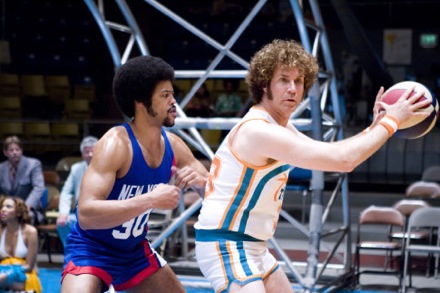
In Will Ferrell’s quest to blanket the history of film with comedies on every single sport known to man, comes an afroed former disco singer with a basketball team.

“Semi-Pro”, Ferrell’s latest ode to sports buffoonery is far from some of the great comedies of the past few years because it lacks a clever premise for the jokes to percolate and, of course, anything funny.

The sad sack Flint Tropics of the American Basketball Association need to finish fourth to be part of the coming merger with the National Basketball Association. Ferrell’s Jackie Moon is owner/marketer/power forward for the Tropics by way of a bouncy disco tune “Love Me Sexy” that proves to be his best performance of the movie.

The problem with “Semi-Pro” is director Kent Alterman doesn’t seem to know what kind of movie he wanted to make--a slapstick comedy or a romantic comedy.

Most of the confusion is the pairing of Ferrell and the grizzled vet Ed Monix played by Woody Harrelson. Is this movie about Moon’s Tropics or Monix returning to Flint to reunite with his old girlfriend played by Maura Tierney? Three-fourths through the film yet another plotline emerges with the team’s underachieving star fulfilling his dream of playing in the NBA.

This confusion of a leading man runs against what a paying customer would expect from absorbing a major marketing campaign that started on Super Bowl Sunday and included cross-promotions with Bud Light and Gillette.

This comedy is about Will Ferrell’s character as much as the 90’s sitcom “Family Matters” was about Steve Urkel. Sadly, Ferrell is just a constant distraction from the lack of any discernible focus.

Like a cross-court pass that is telegraphed and stolen by a quicker defender, many of “Semi-Pro’s” featured bits have punch lines that are anticipated a mile away.

When the team meets for a game of poker at Moon’s house, a misspoken “Jive Turkey!” forces the color analyst to brandish a pistol. The weapon turns out to be unloaded, so they think. The characters each grab the gun and perform their own improvisations, including Moon hilariously feigning, “I shot myself in the wiener.” From the first improv, it’s clear that someone is going to be accidentally shot.

There are some shining performances in Semi-Pro, though. Benjamin, who plays the cocky, but talented hoopster, who goes by many names, including Coffee Black, in an obvious nod to the late 70’s star World B. Free, actually looks like he can act.

Andrew Daly plays the straight-laced Tropics play-by-play announcer Dick Pepperfield to the highest laughs in the film. His by-the-book description of the first alley-oop in basketball history is a great movie quote in the making.

Sadly, “Semi-Pro” is a movie reminiscent of recent comedies like "Superbad" and “The Brothers Solomon” that isn’t based on a funny script, but comedians leaning on the film’s “R” rating to allow them to say pour out explicative for the sake of shocking the audience.

You can go to any bar or stand on any corner and hear a mildly funny person stringing together a litany of curse words and get a chuckle. For the high price of admission something just a bit more creative is due.

Sunday, March 02, 2008

Muslims Sense Prejudice In Clinton's Campaign Tactic

DRUDGE REPORTS CLINTON STAFFERS PROLIFERATED TURBAN PHOTO

By Steven Tavares

When photos of Sen. Barack Obama wearing traditional garb of a Somali elder and turban, Muslims around the country saw what they feared: a presidential talking point disguised as a proxy against their religion.

In the days since the infamous photo appeared Feb. 25 on the website, “The Drudge Report” Muslims, including bloggers, have criticized the implication of Obama, who is Christian, being tied with extremist Islamic views.

“I don’t like it, but I knew it was coming,” said Nasir Mohammed, a 32-year-old mechanic from Fremont, “Bush dressed up in Chinese clothes and nobody said he was a communist.”

Matt Drudge, the conservative blogger, who also broke the Monica Lewinsky story in 1998, wrote on his website that the photo of Obama, taken during a visit to Kenya in 2006, was distributed by various staffers from the Hillary Clinton campaign.

On Obama’s campaign website, David Plouffe, the candidate’s campaign manager, described the tactic as “the most shameful, offensive fear-mongering we’ve seen from either party in this election”.

While the connotation that Obama is, in fact, Muslim was unsettling, some Muslims are more pragmatic.

Ahmad Helmand, a security guard from Hayward who immigrated to the U.S. from Afghanistan in the early 1980’s, believes that the Muslim world would look proudly to the United States if they voted someone of color or of a different faith than the majority of Americans.

“It doesn’t matter to me, because he said he’s Christian,” said Helmand, “If people want to believe he’s a terrorist, then so be, they’re probably racist anyway.”

A day after Drudge’s posting, conservative talk-show host, Bill Cunningham, introduced Sen. John McCain at rally for his campaign for the republican presidential nomination, by referring to Obama by his entire name, which includes his middle name Hussein.

McCain later apologized to the Obama campaigned, but the meme of the candidate with a middle eastern-sounding name wearing a turban has been set in the minds of many voters.

Juan R. I. Cole, the noted University of Michigan professor who specializes on middle east affairs, found the blatant use of Obama’s full name to be inappropriate.

On his website, he wrote, “Denigrating that name is a form of racial and religious bigotry of the most vile and debased sort. It is a prejudice against names deriving from Semitic languages,” said Cole.

He also noted that other famous Americans in history like World War II Gen. Omar Bradley and Benjamin Franklin also had derivations of middle eastern surnames.

“I don’t think people really care what a person’s name is as long as they have money in their pockets,” said Mohammed.

Thursday, February 14, 2008

McCain Needs To Heart Huckabee As Veep

SOUTHERNER IS BATTLE-TESTED AND FUNNY...FOR A POLITICIAN

As fast as he could say, "Shazzam!" the Gomer Pyle-esque former Arkansas governor became a presidential player, again.


After winning the Iowa caucus last month, he went from Hucka-who? to “I heart Huckabee” before acting like a downright huckleberry.

The roller coaster campaign of Mike Huckabee was saved by the South and, maybe, Jesus himself.

 While he didn't sufficiently slow the John McCain Straight Talk (soon-to-be-less-candid-GOP-nominee) Express from streaking to the national convention in the Twin Cities, he did boost his chances for a place on the Republican ticket.


The McCain/Huckabee dynamic must be viewed as a mixed bag. The Republican came a step closer to anointing the latest heir to Ronald Reagan, but Huckabee's strong showing in Dixie again reveals an enormous fissure within the God-trumps-your-Constitution set and independent voters who enjoy McCain's willingness to reach across the aisle.

Is there another evangelical Christian in the Republican party up to the task of making conservatives feel whole other than Huckabee?

 If one existed it’s likely they would already be in the race where a bonafide red-meat-eating conservative is nowhere to be found.

Although he was successful early in Iowa, he never had the presidential purse strings or the willing donors to make much of a run, anyway, but his ability to preach to Southern values is his most valuable asset.

McCain has shown that he is unable to win in a Southern state other than South Carolina, where he has a unique history and a boatload of servicemen. Evidently, Huckabee has such sway south of the Mason-Dixon line that he easily won Georgia, Tennessee, Alabama and his own state, Arkansas.


Obviously, it seems like a marriage made in heaven and they even like each other or share a common contempt for Mitt Romney.

 Such a ticket has inherent problem, though.


Many attribute McCain's earlier fall from grace, last year, to the fact he sold out his sterling reputation as a maverick politician when he courted President Bush's Christian cohorts. When he bowed at the altar of the late Jerry Falwell, he lost all of his street cred in Independentville, USA.


Now that "Mac is back", he might, again, be forced to court that same constituency or lose the general election. Without someone like Huckabee, McCain would have to cobble together an deadlocked electoral scenario without the GOP's main voting bloc, the Deep South.


McCain's version of the “Southern Strategy” forces a conundrum. Veer hard to right as he unsuccessfully did last year or softly shift to the center of left and make Rush Limbaugh and Ann Coulter blow steam from their ears.


Outside the political nuts and bolts, Huckabee as VP has many desirable traits. He battle-ready after honing his message on the stump for the last year. He folksy and, by the low standards of politicians, pretty funny.


What's not funny is some of beliefs. 

This is a candidate who, at times, sounds more like a West-hating cleric than an American Baptist preacher. Last week he said, 

"I believe it's a lot easier to change the Constitution than it would be to change the word of the living God, and that's what we need to do is to amend the Constitution so it's in God's standards rather than try to change God's standards."


He also supports rewriting the 14th amendment by denying citizenship to children born to illegal immigrants.

 Behind his quick affable persona and quick-fingered bass playing lies something as poisonous to McCain's presidential aspirations.

It's a deal with the Devil that he flirted with before, but with the White House within his reach, McCain/Huckabee '08 may be his only chance.

Tuesday, February 12, 2008

Code Pink Awaits Pre-Dawn Protesters From Across Nation

POTENTIAL CLASH A PRELUDE TO CONTENTIOUS CITY COUNCIL MEETING

By Steven Tavares

BERKELEY, Calif - Members of the anti-war group, Code Pink, camped in front of the old Berkeley City Hall Monday night awaiting an early morning clash with pro-war groups angry over the city council’s stand against a Marines recruiting center.

The Berkeley City Council is slated to discuss the controversial decision to draft a letter declaring the Marines unwelcome in the city on Tuesday night.

In the meantime, both sides are girding themselves for a contentious display of protesting in front of the Maudelle Shirek City Hall beginning at 5 a.m.

Code Pink organized an emergency 24-hour demonstration starting at 7 p.m. Monday night that will lead into the city council meeting Tuesday night.

Organizer from the pro-war group Move America Forward countered with a pledge to arrive for their own demonstration at the crack of dawn.

“They believe they’re protecting our children. We’re not at odds with that. Some of us just have different ideas on how to do it,” says Berkeley resident, Patty Bailey.

Erik Freeman, who served time in the Vietnam War, drove his RV from Bakersfield as a member of Move America Forward and arrived early to witness the protesters beforehand.

“This whole thing is about picking on the Marines,” said Freeman, “Our thing is to make it clear to the city council that we’re unhappy with their resolution.”

Freeman was also unimpressed with the manner in which the protesters were behaving.

“For a war protest, they’re having a whole lot of fun,” said Freeman.

The scene on Martin Luther King, Jr. Way had elements of a carnival with protesters clad in pink shirts dancing on the sidewalk, singing protest songs and snacking on vegan meals donated by a local eatery.

“Code Pink showed up for a pajama party,” said Freeman.

Cynthia Papermaster, another member of Code Pink, expects the pro-war protesters, some of which are believed to be traveling from as far as Colorado, will be discourteous and aiming to provoke a physical confrontation.

“We’re planning on being peaceful and non-confrontational,” said Papermaster.

Others are surprised by the worldwide attention this topic has received and see it as a telling sign of how unpopular the war has become.

“This is an indication of how scared they are about losing the war,” said Zanne Joi, who has been affiliated with Code Pink since its inception.

“We live in a country of lies and spin and one of the most successful lies is that if you’re against the war, you’re against the soldiers. I’m proud that our city council did not buckle under the pressure,” said Joi.

Freeman believes these types of demonstrations against the war puts our troops at risk and shows our enemies our weakness.

“They’re just allowing our opponents across the ocean to say, ‘Look, America is against the war’,” said Freeman.

The organizer behind Code Pink has staged weekly demonstrations in front of the recruiting center located on Shattuck Avenue for months.

Using a bullhorn and motherly powers of persuasion they attempt to detour prospective men from enlisting.

According to Papermaster, they have been known to enter the center and dissuade the men on the spot.

Primarily made up of mothers against the war, they successfully closed down an Army recruitment center on Broadway Avenue in downtown Oakland last year after continual protests.

Sunday, February 10, 2008

'Anonymous' Protesters Descend On Berkeley Scientologists

TWENTY GATHER AS PART OF GLOBAL PROTEST ORGANIZED ON WEB

BERKELEY, Calif. - A small, but boisterous group clad in black masks and calling themselves “Anonymous” protested the Church of Scientology in Berkeley yesterday with a globally-coordinated movement that grew momentum through the web and YouTube.

Yelling “You’re cruising for a bruising, Tom” and holding a sign that read “Honk if you are against Scientology”, the protesters, a majority in their in early 20’s passed out leaflets downloaded from the internet, but failed to attract confrontation from the Scientology building on Shattuck Avenue.

Many in the group said that this was their first demonstration of any kind and all were drawn to the protest through articles on the internet and the heavily viewed videos available on YouTube.

One demonstrator, a student who traveled from Cupertino with his friend and calls himself “Anonymous” as many in the group did said he was drawn to the hype that surrounded the viral video.

“I wanted to tag along,” he said, “I heard about it from my friend and it didn’t seem right what they’re doing.”

The original Anonymous clips have been viewed over 2 million times as of Monday night and consists of noir-style backgrounds of clouds and buildings with a soundtrack of a computerized voice detailing the faceless groups manifesto against the Church of Scientology.

A few of the demonstrators admitted that they knew little about Scientology before the YouTube videos or said their only exposure to the church was through the controversial “South Park” episode that told the story of the groups belief that an interstellar warlord named “Xenu” brought misery to Earth.

Anonymous recounted how when he found information about Scientology on the web, he realized there wasn’t much difference between what he found and the cartoon episode.

“Basically, what I saw on that South Park episode was the truth,” he said.

A Cal student named Liz had a different history with Scientology than the others.

Her uncle was a former Scientologist about 30 years ago who left the church when he ran out of money for the group’s dollar-tiered path to enlightenment.

She says that the church still routinely calls her uncle about returning decades later.

The Genesis of the confrontation began weeks ago, when an unauthorized internal video of Scientology’s most famous adherent, Tom Cruise, appeared on the internet.

The extensively edited video of Cruise detailing the pleasures of Scientology intended for followers of the faith was quickly pulled by YouTube after the church, known for being aggressively litigious, complained to the site on the grounds of copyright infringement.

But, what began as a protest by young, computer hackers angry over the suppression of information morphed into a spotlight on the many of the church’s controversial practices of including accepting money to further a believers standing in the group and its standing as a tax-exempt non-profit organization.

A man from San Leandro named Shandu disagrees with the church retaining a tax exemption since 1993 as religious non-profit.

“I have a problem with them having a non-profit status when they don’t help anyone,” said Shandu, “They don’t feed the poor or help children like other churches do,”

Shandu, who once protested Apartheid in the 1980’s, was not alone in being concerned about the church’s reputation for ruthlessly tamping down dissent through intimidation.

“I can’t afford to weather a big lawsuit. Even if it was a B.S. suit, you still have to get a lawyer and they can just keep the case going for years,” said Shandu, “They have that kind of financial power.”

Added Anonymous: “It’s why I brought the mask. I’ve heard rumors about them destroying protester lives.”

The protester named Liz was far more defiant.

“They can’t get me, but part of Anonymous is that they are afraid of Scientology’s power. That’s why we have to hide our identities,” she said.

The Anonymous movement, in fact, detailed a list of 22 rules that followers should adhere to, including, demonstrating across the street from Scientology buildings, cooperating with law enforcement and disguising their identities with masks, sunglasses and hoods.

Many at the three-hour demonstration believe representatives from Scientology were covertly watching the group.
They detailed a man clad in dark blue who intently watched the group for over 30 minutes while intermittently speaking on the phone.

Two women also intentively watch the demonstrators while one video taped the action and the other jotted down notes.
The two were masked similarly to the Anonymous protesters, but when asked to join the group, they said they were “independent”.

Later they handed demonstrators small pieces of paper with a handwritten e-mail address.

With the undercover and mysterious mood of the two groups, few said they were willing to act upon the e-mail address.

Thursday, February 07, 2008

College Students Not Keen On Saving Rebate Checks

BILL'S EFFECTIVENESS BASED ON WILLINGNESS TO SPEND

HAYWARD, Calif. - The success of the $150 billion stimulus plan that President Bush and Congress agreed to last week depends on one thing: that people will spend the potential $1,800 rebate checks quickly, but many Cal State-East Bay students are not buying the premise.

“I would spend some and save some,” said Joe Pecoraro, a senior majoring in accounting, “I tell my friends to save, too, but they usually don’t.”

In interviews across campus, he and others expressed various preferences for the use of the possible funds, which the Bush administration hopes may jumpstart an ailing economy.

Freshman Aurelio Padilla travels from Oakland to school using BART and buses and might put a rebate check from Uncle Sam towards some new wheels somewhere down the line.

“I would probably save it and put it towards buying a car,” said Padilla.

Others like Angelica Gonzalez, freshman majoring in nursing, are inclined to save the money to use later in the year.
“I would probably save it for books in the fall,” said Gonzalez.

But, she also admitted that she might spend it during her yearly summer vacation in Mexico, which would benefit that country’s economy more than the U.S.

The problem is that saving the money or paying off a delinquent credit card bill is not what the stimulus bill is intended to do.
The Federal Reserve, which oversees the nation’s treasure chest, would rather have people spend, not save the checks, which could run anywhere from $300 to nearly $1,800 for taxpayers who have the maximum four dependents.

Most economists agree that the economy needs a quick injection of money to lessen the burden of a shaky housing market and a precipitous rise in foreclosure due to iffy sub-prime loans.

If the stimulus bill is passed by Congress, the rebate checks, which could arrive in the mailboxes of many households in May, will carry no conditions on how they are spent, but, instead, present a policy gamble by Washington that they will wiggle the economy out of the grasp of a possible recession.

CSUEB economics professor, Lynn Paringer, believes the best way to help the economy is to get the money into the hands of people with lower incomes.

“It’s fair to say that lower income people are more inclined to spend it more quickly,” said Paringer.

Depositing the checks in your savings account will help the economy in the long run, but not as quickly as the government wants.

“If it goes to a bank you won’t see it helping until after a cycle,” but Paringer added, “If you put it under your mattress, nothing happens.”

Paying your debts with the money will help your personal finances, but also won’t do much for the economy in the short term.

Graduate student, Moises De Loera, who is closing in on his teaching credential, might apply the check towards his school loans.

“I need to pay some bills and I have school debts,” said De Loera, “and it’s almost time to pay those bills.”

Paringer says if that paying off your bills will help the economy, but not until that money is able to be invested down the line.

She believes that the key to helping the economy is through targeting the stimulus towards businesses, but details of the stimulus bill will have to limit what areas they invest.

“What if your business is working at capacity? Will you invest? And what’s to say they don’t invest in the U.S.? Will this create incentive for businesses to build new factories or hire more workers,” said Paringer.

The agreement that President Bush; Speaker Nancy Pelosi and Minority Leader John Boehner arrived at last week did not include demands from Democrats that the stimulus include extending unemployment insurance and bolstering food stamp programs, but did include tax incentives for small businesses that Republicans favored.

Senate Democrats said Monday that they will seek to include benefits for unemployment insurance and food stamps in their plan, both areas that economists believe people will quickly spend their checks on rent or staples food and clothing.

During his State of the Union speech, President Bush said any attempt to deviate from his agreement with Congress will “delay or derail” the stimulus bill.

He also reiterated that the bill must be passed quickly to have any effect on the economy.