Portuguese forcados pile up in an attempt to stop the on-rushing bull. Bullfights, typically held on Monday nights, attract large followings within the dense Portuguese population of the California Central Valley.
BAREHANDED FORCADOS CAN'T SUBDUE BULL; TWO INJURED AT GUSTINE FESTIVAL
By STEVEN TAVARES
The Pioneer
GUSTINE, Calif.(Sept. 15) - Michael Lopes was minutes from meeting the bull agitated by the horse-ridden matador.
The bull, all thousand pounds of muscle, speed and ground beef, was doing what stereotypical bulls do. He raked the barren soil with his hooves and chased the horse with blind anger.
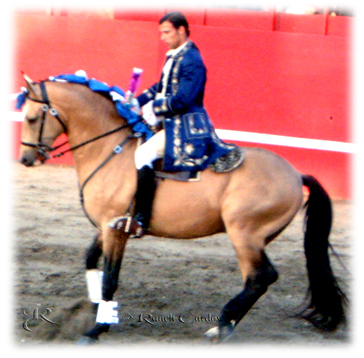
In the meantime, the cavaleiro—the rider adorned in aristocratic garb teased the bull as he instructed the horse to perform a few tricks and pirouettes in the centuries-old equestrian tradition of dressage.
In Portuguese bullfighting, it is the mounted cavaleiro who revels in the spotlight, not the cape-wielding matador as typically seen in Spanish bullfighting. The Portuguese do not mortally wound the bull, at least until 2002, when the government legalized fighting bulls to the death. However, the act is illegal in the United States.
Instead, the cavaleiro relies on garland decorated javelins tipped with something similar to Velcro to attach his spear to the bull's shoulder blades.
Lopes and his team of seven other forcados—also known in the states as the “suicide squad”--are the final act in this bullfight. Their job is to not only subdue the rampaging bull but to do it with their bare hands. (Watch a video of forcados in action, here.)
They wear stately embroidered red coats with a thin red tie tucked into a wide red sash tightly wrapped around the forcados waist. Tight copper pants with long white lacy socks finish off the ensemble.
It's a nervous time for the suicide squad. As they await their cue, some animately chat with each other in a nervous matter of speak. Others hop in anticipation, while a few stand with their backs to wall, sullen with terrible blank stares, “What did I get myself into?” they seem to be thinking.
During this particular bout, the cavaleiro is having a difficult time tormenting the disinterested animal.
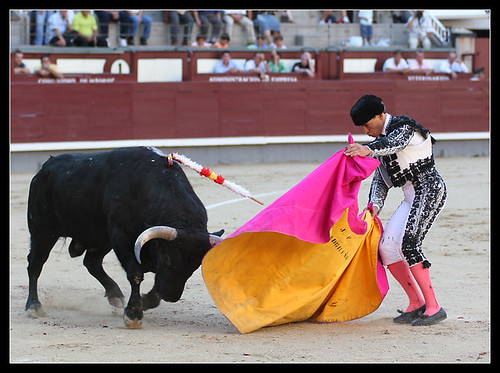
Bandariheiros—helpers dressed in tight fitting light blue and pink outfits—try to animate the bull by waving their pink and gold capes. This picks up the pace, but the bull is dangerously filled with energy too close to the entry of the forcados.
Before his triumphant exit, the cavaleiro elicits a brief moment of action. Clutching a blue javelin, his horse scampers before the bull. The bull is now tailing the horse like a stock car racer kissing the bumper of the lead car.
His horns at the horse's backside, the bull jerks his head upward to gore the equine with his horns.
At the last moment, the horse accelerates out of danger. Demoralized, the bull eases up only to find the cavaleiro doubling back to stick the spear into the bulls muscular shoulder blade.
The crowd roars as the cavaleiro makes his final sweep around the ring. White roses are thrown and he exits.
This is the suicide squads cue.
Jorge Martins acts as their coach. He roams the outer ring of the arena like a hockey coach, passing advice and choosing which of his men will be up to the task of bringing down the bull.
Like a baseball manager tabbing his rookie pitcher to start his first game, Martins doesn't announce who will be the caras—the lead man to confront the animal—until minutes before showtime.
He chooses Lopes.
This will be the seventh time this season Lopes will perform the pegas de caras—the face catch.
The team jumps the fence in unison and gathers at the center of the ring in a single-file line. It is interrupted with two husky men side-by-side near the middle of the formation. The bandariheiros are busy readying the bull at the far end of the ring.
“You don't hear the crowd. The only thing you hear is your captain talking to you,” said Lopes,” You're just locked in on the bull waiting for him to come. When you have to reverse it's a split second thing”
Lopes stands poised. His human instincts to fight or flee are at a heightened level. He slowly cocks his head back, lunges forward and stomps his feet before the bull while ushering out a guttural roar from his lungs.
There's a problem, though. The bull did not seem to care that eight humans are ready to take him down.
The element of surprise is now firmly on the beast's side.
“Usually when you provoke the bull the first time he comes, but he wouldn't. I just wanted to get it over with” said Kevin Vieira, 24, from Fresno.
After a more deliberate stomp, the bull begins to turn his attention towards the group. The line begins to lose it rigid shape to witness the bull's inaction.
“We're single file so you don't know when the bull is coming until the guy in front moves,” said Vieira, “The bull wouldn't move, so we were zigzagging.”
Another stomp from Lopes and the bull rushes.
Lopes frantically backpeddles as he is taught and catches the bull's head with his rib cage. His body twists and jerks from the immense strength unleashed by the angry animal.
One by one the bull drives into the mass of human bodies as they pile up on his head he slowly comes to a stop.
The last forcados job is to grab the bull's tail and pull with all his might. The crowd again roars as the forcados release the bull's head to leave the lone man spinning in a neat circle as the bull chases the man clutching his tail.
There's a mix up in the transition, though.
Twenty-year-old Eddie Mulgado, in just his third bullfight, is caught in no man's land. Lying prone before the bull, Mulgado is just feet away from the unleashed bull.
The bull pounces on the unprotected Mulgado and quickly smashes his heavy hooves on him.
“I could feel the presence of the bull's head on my back,” said Mulgado, “Things happen so quick that I didn't know what was going on, they just told me to stay down.”
Bandariheiros flash their capes to distract the bull away from the object of his ire and Mulgado flees the scene.
A fearful pall casts over Mulgado's face in his dash—the exact replica of every eminently doomed teenager in any slasher film moments before death.
Once he realizes his mortality was safe, his expression turns to anger and he punches the arena wall.
“I felt like I let the team down,” he said.
When order is restored, the cavaleiro, his bandariheiros and Lopes basked in glory as they wave triumphantly to the crowd clutching flowers.
Lopes, 19, a sophomore at St. Mary's College, was uninjured except for a few scrapes.
He says he's quite superstitious regarding his hobby. He even makes a point of attending Sunday Mass just in case.
His routine has worked so far, he's never faced a serious injury in three years of bullfighting, yet his father worries about the imminence of that day coming.
“It's like the actuary tables that insurance companies use, the longer you do it, the more you're at risk for something going wrong,” said Frank Lopes, “So, just like anything else, you've got to know when to hang it up.”
Lopes' mother and grandmother have never attended one of his bullfights and his sister has only attended a few.
The fear of witnessing a family member face such violence is quite universal among the suicide squad.
“It's really easy to enjoy it when you're watching someone else that you have no connection to,” said Frank Lopes.
Steve Lemos, 29, has been a part of the team for 11 years and he still receives gentle hints from his wife that he should quit.
She has reasons to be worried.
Lemos tore up his left knee this year and suffered a broken jaw which wired his mouth shut for seven weeks and caused him to shed 25 pounds on his already lanky frame.
Lemos turned his shaven head to reveal another injury: a large “J” shaped scar from the glancing blow of the bull's hoof.
The offending bull was tall and had a propensity to learn quickly, Lemos said.
“He went to defend himself with his horns,” said Lemos, “When I lined up and called him a second time and went to him, he came up with his horn right in the bottom of my jaw and picked me up by my jaw and that was the end of that.
“You've got to respect what you're doing and you have to go out there confident in the boys behind you,” said Lemos. “As long as you've got people you trust and people that know what they're doing behind you, it's relatively as safe as anything else.”
Yet broken down to its most basic parts, it's still man versus beast.
“It is an an animal out there and it's defending itself and you're going at it—it's very dangerous,” cautioned Lemos.
This point became very evident during the group's second bullfight later that night as full moon hung over the Cental Valley night.
A new lead man replaced Lopes and faced a superior bull that quickly adapted to each of the forcados attempts to quell his anger.
“The bull was coming in fast and low. We just couldn't stop him,” said a spent and sweaty Derek Santos of Turlock.
On each of the five attempts to subdue this particular bull, the same scene occurred with casualties slowly mounting.
The lead man would react slowly to the advancing bull, fly off violently and sometimes flip under the rampaging bull while holding on for dear life.
The eight men were demolished every time like the Kool-Aid man busting through a wall. A bowling ball rushing through pins comes to mind, but bowling pins do not break like these men.
Martins, the leader of the team, quickly reassessed the situation, made personnel changes and instructed the team to close the space between each forcado.
“He told us to make the bull hit all of us at once, so he wouldn't have as much power,” said Santos.
After a fifth and ultimately final attempt, the bull left a young man unconscious with a gash on the back of his head and another with broken ribs and a punctured lung.
As paramedics tended to both and attached an IV and heart monitor to the last victim, the once complimentary crowd turned angry.
Older Portuguese men, seeing their own sons in these young gladiators, rose to their feet with as much menace as the snarling bull and yelled towards the organizers, Vai por rua!--which colloquially means “get out of here”, at least, in polite terms.
In Portugal, the forcados usually return to the ring for as many times as it take to subdue the bull. On a recent trip to the Azores, it took seven tries to bring down the bull, Santos said.
Tonight, five times was enough.
The arena soil, once littered with the prints of horses and bulls now showed the unmistakable parallel lines of stretchers and the shoe prints of medical personnel.
The forcados paced the outer ring of the arena. Most with stuttering limps and bent over at the waist in exhaustion. The young men once filled with nervous exuberance, now more closely resembled a beaten regiment of World War I soldiers disoriented in their dirty trenches.
“I'm going to be sore tomorrow,” said Santos, “I'm going to drink a lot of wine tonight, I can tell you that much.”