Showing posts with label FDR. Show all posts

Wednesday, April 15, 2009

Pelosi Calls For Commission to Investigate Wall Street Tricks

SPEAKER ADDS SUPPORTS TO PLAN RECENTLY GAINING MOMENTUM
With an eye towards quelling the populist anger roiling across the nation, House Speaker Nancy Pelosi today called for the creation of a commission to root out the causes of Wall Street's meltdown patterned after an obscure Depression-era committee.

In San Francisco to speak about her book encouraging the rise of women in society at a gathering for the Commonwealth Club of California, Pelosi said Americans are angry with the economy and bonuses given to AIG and said at least 75 percent want an investigation into the missteps that led to this recession.
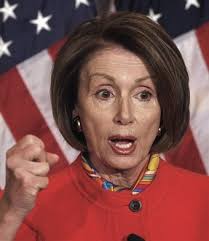
"That's what we would do with this commission, is to make sure it does not happen again." she said.

Pelosi spoke with Treasury Secretary Timothy Geithner this morning about the plan to emulate the Pecora Commission created in 1932. That commission named after the Deputy District Attorney of New York County Ferdinand Pecora followed two failures and benefited by Franklin Roosevelt's election. The commission's findings led to the Securities Act of 1933 and the creation of the Securities and Exchange Commission,itself, alleged to have been lax in regulating Wall Street with Bernard Madoff's infamous Ponzi scheme being the poster boy for this age of decadence.

“Some people can tell you one piece of it. Others can tell you another piece of it. It's really hard to know. Do you understand it?” Pelosi asked rhetorically, “We need a clearer understanding of how we got here.”

Pelosi is not the first politician to allude to the Pecora Commission in recent weeks. Sen. Byron Dorgan called for a new iteration of the committee along with reinstituting the Glass-Steagall Act whi9ch separated commercial and investment banking. Many believe its repeal in 1999 was the impetus for banks and investment firms like Citigroup and Travelers to merge and allow the subprime credit markets to run rampant. A New York Times editorial last month also called for a Pecora-like commission to be created.

Earlier in the day, appearing on the local Fox affiliate KTVU, Pelosi characterized an upswing of “Tea Party” tax protests as window dressing for elite conservative interests in lower taxes calling them “Astroturf”, as a manufactured antonym for “grassroots”.

The Speaker drew upon her personal biography to encourage woman to continue to rise to more positions of power. Her book, Know Your Power: A Message to American Daughters urges woman to get involved in all aspects of community service. Pelosi, herself, is the daughter of the Baltimore establishment and said she found politics both exciting and distasteful. “It taught me I didn't want to be a part of it,” she said.

While raising five children with husband Paul Pelosi, who incidentally spent the speech doting over their newest grandchildren, she slowly became immersed in Bay Area politics with her big break occurring in 1976 when she secured Maryland for a youthful Jerry Brown in the Democratic presidential primaries. Pelosi joked, though, the then-Governor of California had a problem with saying, “thank you.”

Despite no longer being in office and playing to the liberal San Francisco audience, Pelosi also had a few jabs for former President Bush. While saying she “absolutely loves” working with President Obama, she said “having a great intellect saves a lot of time.”

Wednesday, March 25, 2009

Obama Angles To Allow Potheads To Chill

FDR LEGALIZED ALCOHOL IN 1933 TO CALM AMERICANS
The parallels between the first 100 days of the Roosevelt presidency and that of Obama's have been much commented upon, with Roosevelt's first days being used as a yardstick for legislative achievement or at least activity. Now a new link between the two eras has begun to emerge: the decriminalization of marijuana.

In 1933, after Roosevelt enacted a steady stream of legislation to secure the nation's economy that would last generations, he repealed the 18th Amendment allowing for the sale of alcohol. While it was long a Democratic desire to do so, the practical reason was to generate tax receipts from the sale of liquor and expand various programs to put people back to work. It seems times have not changed much in 76 years.

Former San Francisco Supervisor and current State Assemblyman Tom Ammiano says the flailing California economy could receive a $1 billion boost by taxing the sale of marijuana. The legislation is currently in Sacramento. According to a Time article, the estimated $14 billion in sales of the drug would nearly double the state's next largest cash-crop -- milk and cream.

U.S. Attorney General Eric Holder also signaled that the government is beginning to soften its decades-old stance against marijuana when he said that federal raids against California cannabis clubs would cease (such dispensaries are legal in the state) and states would be allowed to make their own laws on the subject.

As populist anger continues to bubble over regarding the economy, a steady stream of huge unemployment figures and the current scandal of corporate bonuses paid with taxpayer money, The Nation's Alexander Cockburn thinks making pot legal might calm the citizenry the way making alcohol legal was intended to cool pre-Great Depression America.
Ending Prohibition was functional to social control. If people head for the bars, they'd be less likely to man the barricades, calling for real change. As FDR's popularity soared, so Obama's popularity has soared for dope smokers, among them those whom the herb is the best and cheapest line of defense against pain.
The Internet has cultivated a large following of cogent pleas for decriminalization easily outnumbered by thousands of hokey ideas and conspiracy theories. The functionality of hemp seems to be quite popular on many of these sites. One unlikely voice in the crowd is noted travel author Rick Steves, who recently visited the Commonwealth Club of California to discuss not marijuana, but his film on Iran.

In a interview this week with Salon, the author gave his views on the elitism of many of our laws regarding pot.

The fact is, the marijuana law in the U.S. is a big lie. It's racist and classist. White rich people can smoke marijuana with impunity and poor black people get a record, can't get education, can't get a loan, and all of sudden go into a life of desperation and become hardened criminals. Why? Because we've got a racist law based on lies about marijuana.

It is unlikely a full repeal of many of these marijuana laws would occur under Obama -- the nation and the relative strength of many moderate Democrats and the Republican party would make it difficult even under the guise of increased tax revenue. What the attorney general's announcement indicates is a willingness to look away similar to what law enforcement already does when there are bigger problems than a high schooler smoking pot during fifth period.

This article is featured at The Commonwealth Club of California blog. commonwealthclub.blogspot.com

Tuesday, January 13, 2009

Stimulus Bill Must Think Outside The Nation's Borders

'GLOBAL NEW DEAL' REQUIRED IN AGE OF ECONOMIC INTERCONNECTIVITY

Americans are feeling the economic pinch, but, in many cases, the decisions made in Washington may effect the rest of the world more deeply. In the current edition of The American Prospect, Washington Post columnist Harold Meyerson calls for a "Global New Deal".

Using the example of the American Insurance Group (AIG) and the ability to use its global tentacles to effectively be a company without a country to regulate its business, Meyerson constructs an argument that has received little attention nationwide.

Barack Obama may well seek a new New Deal to right a profoundly dysfunctional American economy. But he faces one constraint that Franklin Roosevelt didn't have to confront in the 1930s: The economy that Roosevelt saved was fundamentally a national economy that could be altered by national policies. The economy that Obama must fix, by contrast, has national dimensions that can be altered by national policies, but in matters ranging from corporate conduct to consumer safety to Americans' incomes, not to mention global warming, purely national solutions no longer suffice. To fix America today requires fixing global systems. The next New Deal won't work if it's only American.

Under the concepts of globalization, a multinational corporation is able to evade basic regulatory oversight that a nationally-based business would have to cooperate.

A report from the Center for American Progress deals more closely with the topic from the standpoint of foreign economies, saying Franklin D. Roosevelt's response to the Great Depression needs to be applied globally.

This common political imperative has created the conditions for an unprecedented exercise in international economic cooperation aimed at stabilizing the world economy and placing it on a stronger and more sustainable footing through a series of structural reforms. This is precisely the approach the creators of the New Deal took to our national economic crisis in the 1930s.

Americans may have a narrow view of the global ramifications of its own financial demise, but this fact need not preclude the newly elected president from scratching it from the national dialogue.

The European economies of Germany, France and England are searching for ways to stimulate their economies, while reports this past weekend say that Greece, Ireland and Spain may have their AAA-credit ratings downgraded because of worsening recessions. Of course, these are relatively rich nations as compared to say, Latin American countries, which are relatively stable, but are all encountering lowered gross domestic product figures in the new year.

Some economic isolationists may deny the inevitability of globalization, yet it exists. The effort to fix the U.S. economy needs to add the discussion of world markets in our national dialogu, because people around the world are beginning to argue that what is good for the United States is not necessarily good for the rest of the world

This article and others can be found at The Commonwealth Club of California's blog commonwealthclub.blogspot.com

Obama's Recovery Plan Moves To The Center

WITH TIME RUNNING OUT, CONGRESSIONAL DISUNITY STYMIES OBAMA

Republican Senate Minority Leader Mitch McConnell says he has no qualms with President-elect Barack Obama's stimulus plan – and that could be a problem in itself.

After eight years of tax cuts under President Bush, some Democrats – especially Northeastern liberals like Sen. John Kerry and Rep. Barney Frank – think that giving tax breaks to businesses and middle-class families will not create long-term job growth. Scott Lehigh, writing in the Boston Globe's op-ed page, thinks tax cuts make little sense and wonders whether they exist in Obama's plan as a carrot to Republicans.

Democrats are also leery about heaping more debt on the books. The Congressional Budget Office estimates the deficit will reach $1.2 trillion in 2009, not including Obama's stimulus plan. Some in Washington also believe the total stimulus price tag will ultimately reach closer to $1 trillion. Obama's preliminary estimate is around $775 billion.

With 11 days until inauguration day, Obama, like President Franklin D. Roosevelt 76 years ago, will be afforded a brief honeymoon period in Washington and this is the impetus for the presidential feel of yesterday's speech at George Mason University.

Former labor secretary under President Clinton, Robert Reich, believes the government stimulus should reach upwards of $900 billion spread over two years and urges for it to be done quickly. "Without federal action, next year could be even worse," Reich told congressmen at a forum discussing the stimulus bill in Washington.

On his blog, Reich urges Congress to spend without caution of overextending itself.

As the buyer of last resort, the federal government must respond if that cycle is to be reversed. In my judgment, this will require a stimulus of about 6 and a half percent of gross domestic product, or a total of some $900 billion, spread over two years. That’s my estimate for the shortfall in private demand. But the federal government should stand ready to spend larger sums if necessary to get the economy back on track toward full capacity. The danger is not that the government will do too much; the danger is that it will do too little, too late.

Reich agrees with Obama's plan to upgrade the nation's infrastructure as does Paul Krugman, but some disagree with the basic Keynesian approach. Larry Kudlow at the National Review mocks Obama's progressive pedigree by saying his stimulus plan is somewhat Reaganesque. "Nobody really believes infrastructure spending will end the recession or create permanent new jobs. However, it’s interesting just how much the Obama plan has changed since the election," he wrote.

Here lies the problem facing Washington: in the shadow of a clumsily rolled out $700 billion bailout for the financial sector where many do not know where the money went and fewer gained any stimulus from the investment, how will what many people see as a chronically ineffective legislative branch deal decisively with the economy? Obama wants a bill ready to sign from Congress by Feb. 13. Speaker of the House Nancy Pelosi is already pushing to extend the deadline. Meanwhile, unemployment reaches 7.2 percent and the prospect of this year being somewhat better than the last decreases


This article and others can be found at The Commonwealth Club of California's blog commonwealthclub.blogspot.com. Also, read about the unspoken demise of employed Americans who are not only making less money per hour, but working less of them.